Mailchimp, you people are brilliant.

I just got the new Mailchimp annual report.
It’s a website.
It’s cool.
It’s simple.
It’s beautiful.
It’s entertaining.
It’s fun.
It’s smart.
It’s worth a look, for sure.


I just got the new Mailchimp annual report.
It’s a website.
It’s cool.
It’s simple.
It’s beautiful.
It’s entertaining.
It’s fun.
It’s smart.
It’s worth a look, for sure.

My friend and leadership group buddy Cheryl asked a bunch of us for our favorite books on branding. I sent her these, and thought I’d post them here for all of you, too. I’d love it if you shared your favorites in the comments.
Brand is a Four Letter Word:
Positioning and the Real Art of Marketing
by Austin McGhie
This is a smart, opinionated overview from the president of Sterling Brands’ Strategy Group with deep experience on the both the client side and the agency side of things. There’s a good interview with him on the Design Matters podcast that will give you a taste of the book. He hates the word “branding”. He contends that a brand is simply a relationship, and that you can’t “brand” anything, you can only position it.
World Famous:
How to Give Your Business a Kick-Ass Brand Identity
by David Tyreman
This is a workbook on defining your brand. I’ve used it as a rough guide in leading two companies through a deep evaluation and redefinition of their brand strategy and found it very helpful. Tyreman worked with Polo Ralph Lauren, Nike, Banana Republic and many other companies and has a kind of enthusiastic upbeat approach that works. I find him a little relentlessly self-promotional, but the core stuff is great.
Start With Why:
How Great Leaders Inspire Everyone to Take Action
by Simon Sinek
Probably my favorite thinker about clarifying who you are and what your purpose is, and letting that drive what you create — as a company and as a person. First got turned onto him by a friend at an agency who was using his concepts in everything they were doing for their clients and themselves. I have drunk the kool-aid.
The Brand Gap:
How to Bridge the Distance Between Business Strategy and Design
by Marty Neumeier
Practical and highly visual, Neumeier presents his ideas in an entertaining and very valuable way. Easy to read. Fun to look it. Awesome cover design. “Fresh” and “relevant” to quote some of the blurbs. Many clear and simple ideas, but not “light” ones. The guy has thought through his subject and distilled it well.
Purple Cow — or practically any of his other books
by Seth Godin
This guy is the big thinker about positioning and marketing businesses. Huge influence, unafraid and committed to getting people out of the fear-driven culture and finding their art as business people. Purple Cow is about being different and remarkable — the essence of a good brand. I have to admit I didn’t like it at first; it seemed a little contrived and precious. But as I’ve delved deeper into Godin’s world through blog posts, interviews and other books, the principles just make more and more sense.
Your turn.
 Why is it that a company can write glowingly about its specs and features and even its benefits and elicit not much more that a yawn? Why do we meet the promises of our politicians with such apathy? Why are we so focused on convincing and manipulating people instead of inspiring them?
We think we make important decisions rationally, but we almost never do. Instead, we are driven by, and respond to, signals that are difficult to articulate, but powerful when we receive them. And to be effective and meaningful, those signals always start with “WHY”.
That’s the premise of Simon Sinek’s fascinating study of leadership called “Start With Why: How Great Leaders Inspire Everyone to Take Action” (Portfolio/Penguin).
You may know Sinek from his TED Talk, which I’ve blogged about previously. His book expands and details those concepts with many examples that go far beyond the few in his video. If you buy his basic premise, that the WHY is the hook that connects us to the brands and ideas we care about most deeply, then his book will flesh out your understanding and give you lots of fodder for your thinking.
I have to admit I’m not a huge fan of Sinek’s writing style. I find him too pedantic and repetitive. But that may also be because this is the kind of book many won’t read cover-to-cover, and he had to include repeated references and reminders to anchor his points. I’ll give him a break on that score because his fundamental idea is so important.
That idea is well worth incorporating into our communications — not just our marketing efforts but our broader role as leaders (and we’re almost all leaders in some sense, but that’s another conversation). We want to start with the WHY. The belief. The purpose. That’s what will enlist followers in our vision. As Sinek points out, Martin Luther King didn’t say, “I have a plan.” He said, “I have a dream.” And millions of people who shared that dream of fairness and equality, who also imagined a world where people were treated like people, thought, “Hey, this guy thinks like I do… he wants what I want.”
Notice that they didn’t say, “Hmmm, that’s an interesting idea.” as if they had never imagined a world like that themselves. King tapped into something that was already there. He attracted the people who already believed what he believed, and then galvanized them to action. They became a movement because of the WHY.
Sinek explains that brands work the same way. People love or hate Apple. But the reason the company has so many rabid fanboys is because they stand for something and are willing to start their communications with that central value. If you identify with their rebellious creativity and obsession with design detail, with their core belief in challenging the status quo and thinking differently (their WHY), you’re on board. And you’ll pay more for it, because it reflects who you are, and meshes with your personal values.
That WHY pulls a company, a leader, a brand, out of the swamp of commoditized, transaction-based competitors. It means you no longer need to offer a lower price than everyone else. It means you don’t need to drive volume with coupons and discounts and sales in a never-ending downward spiral of slimmer and slimmer margins. It means you create products or companies you love and care about, and your customers are people who feel the same way.
That’s why Sinek’s message means so much to me in my own business, and to my clients’ businesses as well, whether or not they’ve read the book. Creating work I care about for people who feel the same way? That’s my dream job. And I bet it’s yours, too.
Grab a copy of Start With Why. And start letting people know what you really value.
Almost 2 million people have watched Simon Sinek’s TED talk on leadership called “Start with Why”, including me (several times). If you haven’t seen it yet, do yourself a favor and spend 18 minutes finding out about the difference between manipulation and inspiration, and how great leaders understand that it’s not about the What. It’s about the Why.
I’m finally reading his book, and it’s enlightening and engaging. I’ll write more about it once I’ve finished it. but the core idea is nicely summarized right here. Check it out.
The courageous Seth Godin talks about getting out of your comfort zone because it’s not safe. Taking a risk? That’s safer.
44 minutes of enlightened conversation.
Retail stores have long struggled with the problem of customers shopping there, but then actually buying the products online. Best Buy and Barnes & Noble are great examples of chains hit hard by the phenomenon. Circuit City and Borders are examples of the casualties.
Now there’s another nail in that coffin: the phenomenally impressive digital fly-throughs being created for new boxed sets like this one from Concord Music Group (Hear Music) for Sir Paul McCartney and Wings.
One of the most difficult things about buying expensive products online is the inability to explore them — to touch and feel and handle and mess with the thing you think you may want to purchase. But a well-done unboxing video takes a huge leap toward giving you that experience. It makes it much more comfortable to part with your $160, to buy something you’ll clearly cherish if you’re a hard-core fan.
By contrast, CMG released their McCartney RAM project without an unboxing video. It hasn’t done as well as, say, their Duane Allman boxed set which did have a video — and which sold out in a week.
The buzz for Wings Over America seems to be working. My cousin Adam, a rabid McCartney fan and collector of many boxed sets, knew all about this one almost immediately. And now you do, too.
(Thanks to my friend Eric Eliel for sending this to me. He worked with Integrated Communications to help produce the package. Can’t wait to see it in person.)
Sometimes one of the hardest things to do is to maintain a message and an idea. People inside your company often get bored long before your target audience even notices what’s going on.
True, we’ve done some campaigns that change completely each year. But usually those were for events and the goal was to create a sense of freshness each time. The Revlon Run/Walk for Women and the Mercedes-Benz Cup Tennis Tournament fell into that category.
But often, clients are antsy to abandon things too soon. It’s the longer view that creates relationships, not the anxious panic that sets in when you’ve been working with the same idea for a while and you think your audience is already bored just because you are.
Trust me. They have other stuff on their minds. You’re really not that important to them. With infrequent placement and a limited budget, they’re barely starting to notice you.
Okay, now the other side of the coin.

If you have a solid theme, a powerful idea, you can milk it. Stick with it — but play with it, expand on it or extend it in ways that keep things fresh, entertaining and engaging.
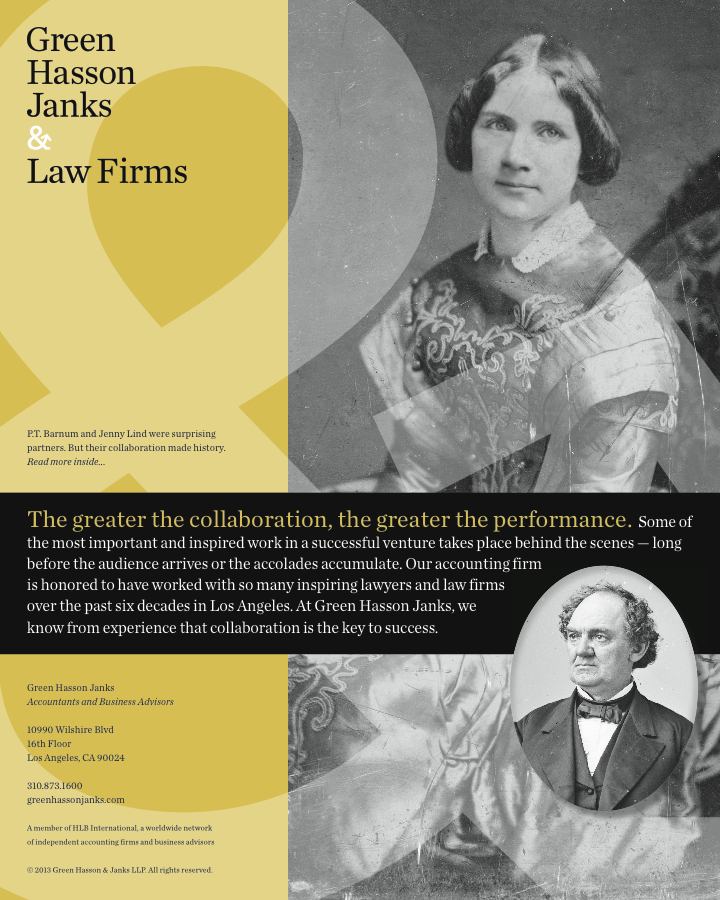
Our Collaboration campaign for Green Hasson Janks seems to get more interesting the more we develop it. The stories (thanks to writer Emily Hutta) are fascinating and surprising. And the collection becomes even stronger as a series.
We’re in our second year and this concept just keeps going. The latest incarnation appears this morning (Monday, March 11) in the Los Angeles Business Journal in the List section on Top L.A. Law Firms. The QR code links readers to the Green Hasson Janks website for the full tale.
Take a look. Even you might be curious about how P.T. Barnum and Jenny Lind’s legal contract was so central to their success.

We recently finished a presentation kit for the Los Angeles-based accountants and business advisors Green Hasson Janks. Ordinarily a folder isn’t something I’d crow about. But this one’s really special.
Designed as a container for new business presentations, it features an unexpected twist on the firm’s key graphic element — a bold ampersand with an upward arrow known in the firm as the Uppersand. It’s their symbol of collaboration and is featured prominently in all their marketing materials and advertising. (More on that next week.)
We deconstructed the symbol, overlaying copies of it to create beautiful abstract shapes where the solid portions overlap. As you open the folder, these shapes resolve into the actual ampersand which is fully revealed on the three-panel interior.
 The effect is enhanced by the overall velvety matte aqueous coating which plays against the mirror-gloss finish of spot UV varnish. That high shine reveals the full ampersand as the abstract graphic elements merge. This coming together to create a powerful whole is, of course, the whole point. It’s a message that’s subtly alluded to by our visuals, and strongly stated in the text.
Kudos to our senior designer Kevin Consales for this beautiful concept, to ColorNet Press for the meticulous execution, and to Green Hasson Janks for the courage to try something powerfully different as an expression of their brand identity.
 After 3-1/2 years of design, content creation and development — with many stops and starts and long pauses along the way — the new UCLArts and Healing site went live yesterday, and we couldn’t be happier!
We worked closely with the energetic and forward-looking Founding Director Ping Ho, who helped start the UCLA Cousins Center for Psychoneuroimmunology (PNI), is co-developer of the program Beat the Odds: Social and Emotional Skill Building Delivered in a Framework of Drumming, and was the principal investigator of the study upon which that program was based. She was a great client — demanding, inquisitive, passionate, and open to new ideas at every turn.
UCLArts and Healing is a partnership between the Arts and Healing Initiative (a nonprofit organization), and the UCLA Collaborative Centers for Integrative Medicine. The site is intended to be a rich resource for educators, caregivers, psychotherapists, health professionals, and anyone else who is interested in using the arts as a vehicle for development, healing and growth.
We wanted to capture the energy, fun and uplifting sense of life associated with the arts — and especially with these programs — while retaining a sense of professionalism. To do that we balanced bold, playful shapes and colors with clean, well-organized typography. Differentiating UCLArts and Healing was a critical part of our design thinking. We wanted to give the organization its own authentic identity so when you arrived, you’d know it. And you’d be curious and want to know more.
Senior designer Kevin Consales and developer Chris Grau did an amazing job. Our clients, and their clients, are thrilled. Feedback has been overwhelmingly positive. Here’s a quote from one of Ping’s latest emails:
Thanks, Josh, for your brilliance!!! I think it will continue to blow people away and exactly meets the goals I set for the site. Thank you.
UCLArts and Healing is an organization with real vision and a powerful sense of purpose. We’re happy to have helped them further their good work.
 I was at a workshop yesterday and met some folks (not shown here) who have been developing websites for 12 years. “Old hands” like them know a lot about the Web, and they are very skeptical about the value of Search Engine Optimization. My developer associate Chris seems to feel pretty much the same way. Unless you are a truly Internet-driven business (a la Ebay or Zappos — and even then) it’s nowhere near as important to your site’s success as creating great content. And doing SEO well is an art form that not many people have the skill, the patience or the budget to practice.
What’s more, if you overdo your SEO, you can end up with text-heavy, unreadable copy — a site that’s so dense with search-friendly keywords that nobody will want to read it. Visitors might show up, but they will leave just as quickly to find a site that’s more usable. That’s not what you want.
In addition, many so-called SEO “experts” use techniques that are manipulative and shady. But now it seems that Google is onto them. Again.
Google’s whole focus (in addition to making money hand over fist) is in generating real, useful results for your searches. They have legions of very smart people who do nothing but find ways to undermine and sabotage the SEO scam artists. They want to give users results that are actually useful. So if you have a bunch of stupid, auto-generated links to your site from blogs that have been mined by robots, your website traffic is about to crash and burn.
Eugene Ware, the CEO of Noble Samurai software. has written a pretty clear explanation of this latest development on his company’s blog. Check it out if you want to know more. (Note: I tried to link you directly to the article, but Ware seems to have moved it around. So I linked to the home page of his blog instead. Look for the article called “Google Changes SEO Forever with its Disavow Link Tool – What You Need to Do Right Now…”)
Meanwhile, my expert buddies suggest you focus on making your site useful and informative. If you do, Google will love you. And so will your customers.